Acts
18:19-19:41 When they reached Ephesus, he left them there, but first he
himself went into the synagogue and had a discussion with the Jews. When they
asked him to stay longer, he declined; but on taking leave of them, he said,
‘I will return to you, if
God wills.’ Then he set sail from Ephesus.
When he had landed at Caesarea, he went up
to Jerusalem*
and greeted the church, and then went down to Antioch. After spending some
time there he departed and went from place to place through the region of
Galatia and Phrygia,
strengthening all the disciples.
Now
there came to Ephesus a Jew named Apollos, a native of Alexandria. He was an
eloquent man, well-versed in the scriptures. He had been instructed in the
Way of the Lord; and he spoke with burning enthusiasm and taught accurately the
things concerning Jesus, though he knew only the baptism of John. He began to
speak boldly in the synagogue; but when Priscilla and Aquila heard him, they took
him aside and explained the Way of God to him more accurately. And when he
wished to cross over to Achaia, the believers encouraged him and wrote to the disciples to welcome him. On his arrival he
greatly helped those who through grace had become believers, for he
powerfully refuted the Jews in public, showing by the scriptures that the
Messiah is Jesus.
While
Apollos was in Corinth, Paul passed through the inland regions and came to
Ephesus, where he found some disciples. He said to them, ‘Did you receive the
Holy Spirit when you became believers?’ They replied, ‘No, we have not even
heard that there is a Holy Spirit.’ Then he said, ‘Into what then were you
baptized?’ They answered, ‘Into John’s baptism.’ Paul said, ‘John baptized
with the baptism of repentance, telling the people to believe in the one who
was to come after him, that is, in Jesus.’ On hearing this, they were baptized
in the name of the Lord Jesus. When Paul had laid his hands on them, the Holy
Spirit came upon them, and they spoke in tongues and prophesied— altogether
there were about twelve of them.
He entered the synagogue and for three
months spoke out boldly, and argued persuasively about the kingdom of God. When
some stubbornly refused to believe and spoke evil of the Way before the
congregation, he left them, taking the disciples with him, and argued daily in
the lecture hall of Tyrannus. This
continued for two years, so that all the residents of Asia, both Jews and
Greeks, heard the word of the Lord.
God
did extraordinary miracles through Paul, so that when the handkerchiefs or
aprons that had touched his skin were brought to the sick, their diseases left
them, and the evil spirits came out of them. Then some itinerant Jewish
exorcists tried to use the name of the Lord Jesus over those who had evil
spirits, saying, ‘I adjure you by the Jesus whom Paul proclaims.’ Seven sons
of a Jewish high priest named Sceva were doing this. But the evil spirit said
to them in reply, ‘Jesus I know, and Paul I know; but who are you?’ Then the
man with the evil spirit leapt on them, mastered them all, and so overpowered
them that they fled out of the house naked and wounded. When this became
known to all residents of Ephesus, both Jews and Greeks, everyone was
awestruck; and the name of the Lord Jesus was praised. Also many of those who
became believers confessed and disclosed their practices. A number of those
who practised magic collected their books and burned them publicly; when the
value of these books*
was calculated, it was found to come to fifty thousand silver coins. So the
word of the Lord grew mightily and prevailed.
Now
after these things had been accomplished, Paul resolved in the Spirit to go
through Macedonia and Achaia, and then to go on to Jerusalem. He said, ‘After I
have gone there, I must also see Rome.’ So he sent two of his helpers,
Timothy and Erastus, to Macedonia, while he himself stayed for some time longer
in Asia.
About
that time no little disturbance broke out concerning the Way. A man named
Demetrius, a silversmith who made silver shrines of Artemis, brought no little
business to the artisans. These he gathered together, with the workers of the
same trade, and said, ‘Men, you know that we get our wealth from this business. You also see and hear that not only in Ephesus but in almost the whole of
Asia this Paul has persuaded and drawn away a considerable number of people by
saying that gods made with hands are not gods. And there is danger not only
that this trade of ours may come into disrepute but also that the temple of the
great goddess Artemis will be scorned, and she will be deprived of her majesty
that brought all Asia and the world to worship her.’
When they heard this, they were enraged
and shouted, ‘Great is Artemis of the Ephesians!’ The city was filled with
the confusion; and people rushed together to the theatre, dragging with them Gaius and Aristarchus,
Macedonians who were Paul’s travelling-companions. Paul wished to go into the
crowd, but the disciples would not let him; even some officials of the
province of Asia, who were friendly to him, sent him a message urging him not to venture into the
theatre. Meanwhile, some were shouting one thing, some another; for the
assembly was in confusion, and most of them did not know why they had come
together. Some of the crowd gave instructions to Alexander, whom the Jews had
pushed forward. And Alexander motioned for silence and tried to make a defence
before the people. But when they recognized that he was a Jew, for about two
hours all of them shouted in unison, ‘Great is Artemis of the Ephesians!’ But
when the town clerk had quietened the crowd, he said, ‘Citizens of Ephesus, who
is there that does not know that the city of the Ephesians is the temple-keeper
of the great Artemis and of the statue that fell from heaven? Since these things
cannot be denied, you ought to be quiet and do nothing rash. You have brought
these men here who are neither temple-robbers nor blasphemers of our goddess. If therefore
Demetrius and the artisans with him have a complaint against anyone, the courts
are open, and there are proconsuls; let them bring charges there against one
another. If there is anything further you want to know, it must be settled in the regular assembly. For we are in
danger of being charged with rioting today, since there is no cause that we can
give to justify this commotion.’ When he had said this, he dismissed the
assembly.
Acts
20:17-38 From Miletus he sent a message to Ephesus, asking the elders of the
church to meet him. When they came to him, he said to them:
‘You
yourselves know how I lived among you the entire time from the first day that I
set foot in Asia, serving the Lord with all humility and with tears, enduring
the trials that came to me through the plots of the Jews. I did not shrink
from doing anything helpful, proclaiming the message to you and teaching you
publicly and from house to house, as I testified to both Jews and Greeks
about repentance towards God and faith towards our Lord Jesus. And now, as a
captive to the Spirit, I am on my way to Jerusalem, not knowing what will happen to me there, except
that the Holy Spirit testifies to me in every city that imprisonment and
persecutions are waiting for me. But I do not count my life of any value to
myself, if only I may finish my course and the ministry that I received from
the Lord Jesus, to testify to the good news of God’s grace.
‘And
now I know that none of you, among whom I have gone about proclaiming the
kingdom, will ever see my face again. Therefore I declare to you this day
that I am not responsible for the blood of any of you, for I did not shrink
from declaring to you the whole purpose of God. 28Keep watch over yourselves
and over all the flock, of which the Holy Spirit has made you overseers, to
shepherd the church of God that he obtained with the blood of his own Son. I
know that after I have gone, savage wolves will come in among you, not sparing
the flock. Some even from your own group will come distorting the truth in
order to entice the disciples to follow them. Therefore be alert, remembering
that for three years I did not cease night or day to warn everyone with tears. And
now I commend you to God and to the message of his grace, a message that is
able to build you up and to give you the inheritance among all who are
sanctified. I coveted no one’s silver or gold or clothing. You know for
yourselves that I worked with my own hands to support myself and my companions. In all this I have given you an example that by such work we must support the
weak, remembering the words of the Lord Jesus, for he himself said, “It is more
blessed to give than to receive.” ’
When
he had finished speaking, he knelt down with them all and prayed. There was
much weeping among them all; they embraced Paul and kissed him, grieving
especially because of what he had said, that they would not see him again. Then
they brought him to the ship.
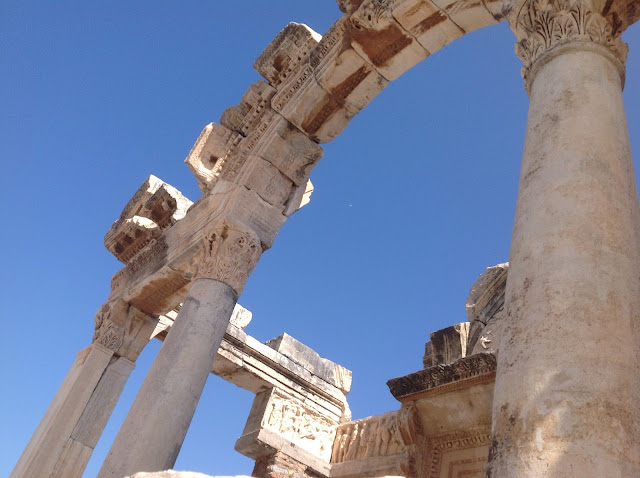
Today we will drive to
the spectacular ruins of Ephesus, undoubtedly the best preserved Classical city
in the Mediterranean and one of the few Greco-Roman sites in the world that
still reflects the grandeur of bygone centuries. Ephesus was the site of one of
the Seven Churches of the Revelation. Greek colonists settled the area 1,000
years before Christ. When the Romans took over, Ephesus was a large port with a
population of over 250,000, the boomtown of Asia Minor. The city played a major role in the
development of architecture, religion and arts.
Despite earthquakes and plundering, much of it remains, giving us
considerable insight into Roman life. St. Paul lived and preached here. The Temple
of Diana (Artemision) is one of the Seven Wonders of the Ancient World. Sites
of Ephesus include the elegant Library of Celsus, baths, theaters, marble
streets temples, fountains and houses.
A short
drive away, the Basilica of St. John sits atop the remains of St. John.
End the
day at the House of the Virgin Mary, who was brought to Ephesus by John (John
19:26-27), the beloved disciple of Jesus. This hilltop home of the Virgin Mary is
visited by over a hundred thousand pilgrims each year. Pilgrims drink water
from the sacred spring and pray for health at this ancient spot of worship. Pope
Benedict XVI celebrated Mass at the House of the Virgin Mary on November 29,
2006 as Paul VI and John Paul II did before him.